25+ years designing, selling and living with hammocks.
I sold my first hammock when the internet was still dial-up, flip phones were the height of technology, and renting a movie meant a trip down to Blockbuster. Almost everything about that world has changed. The hammock hasn't. A good one still doesn't have a USB charger, a Bluetooth speaker, or a string of LED lights, and it has never once needed an update. What has changed is how much people need one: the faster and more stressful life gets, the more demand there is for somewhere to lie down, unplug and do nothing at all. In 25 years I've answered just about every question anyone could ask about hammocks. If you don't find yours answered here, email me at hammocks@kwhammocks.com and I'll answer it too.
Paul Ashwell, Founder, Key West Hammock Company Last updated: September 16, 2026
The Short Answer: Start With Your Space
Most quality hammocks are comfortable. Not every hammock will fit your space. So before anything else, look at where it's going:
The main types of hammock are rope, Brazilian or Colombian cloth, Mayan, Caribbean, quilted and camping hammocks, plus hammock chairs. Not all hammocks are built the same way. The Mayan hammocks of the Yucatán are delicate but remarkably comfortable. The cloth hammocks of Colombia and Brazil were traditionally hung indoors and slept in as beds. The Carolinas gave us the classic American rope hammock on spreader bars, and today's quilted and Caribbean styles are modern takes on that tradition.
Rope Hammock
Nothing beats the look of the classic American rope hammock, which originated in the low country of the Carolinas and introduced the world to the spreader bar. These have thick, heavy-duty ropes in cotton or polyester, worked in an open double-latch weave that lets air circulate and keeps you cool. The open weave also lets leaves and debris fall straight through, though the same gaps can catch a small limb or a pet's paw. Rope hammocks are known for their comfort, but the thicker cords can dig in if the weave is too sparse, the rope is too thick, or the hammock simply wasn't woven with enough skill.
Originally woven on hand looms and now often machine made, Brazilian style hammocks are typically cotton cloth in a wide range of textile patterns and colors, finished with a macramé or hand-crocheted fringe called the veranda for a distinctly bohemian look. They began as indoor beds for the indigenous peoples of South America, and today they're most often hung outdoors under a covered porch or in a sunroom, where the delicate cotton stays protected from the elements. They're exceptionally comfortable, especially when used correctly: lie across the bed at an angle rather than straight down the middle. For the best quality and comfort, look for a large, traditionally hand-loomed hammock from South America rather than one of the small, cheap machine-made copies.
Mayan Hammock
The legendary Mayan hammock is intricately hand woven from hundreds of fine cotton cords in the traditional diamond weave. It's widely recognized as one of the world's most comfortable hammocks, and it was traditionally used indoors as a bed by the Mayan people. That comfort comes with care, though. The larger sizes are the most comfortable of all, but a traditional Mayan needs to come indoors ahead of high wind or rain, and the fine cords are easy to snag, pull or break. It isn't the right hammock for pets, for children at play, or for commercial use.
Our Caribbean Mayan is built for the backyard instead. It keeps the no-bar shape that hugs you, but it's woven from soft spun polyester with much thicker twisted end cords, a clew knot and stainless steel rings, so it stands up to weather, horseplay and the family dog. With no wood to rot, it also closes up when nobody's in it, so it doesn't collect leaves when hung under trees.
Full disclosure: I designed the first Caribbean Hammock back in the early 2000s, so my opinion here is not exactly neutral. The idea was to take the look and the spreader bars of the classic American rope hammock and give it the much closer, far more comfortable weave of a traditional Mayan, then build the whole thing from modern weather-resistant polyester instead of natural fiber. The cord is the part I spent the longest on: thick enough to stand up to kids, pets and horseplay, fine enough to feel as comfortable as a traditional Mayan hammock, and woven so the bed opens just wide enough for cooling air to move through it.
Quilted hammocks are two panels of polyester sandwiching a layer of polyester fiber fill. They have their place. If you want a particular designer color or pattern to match your other outdoor furniture, or you're mostly using the hammock on cool fall evenings, quilted does that well. But from years of watching them in the field, the drawbacks pile up fast. They catch the wind like a sail. They soak up rain and can stay wet all day. And in direct sun the flat polyester absorbs heat like a car seat, so you end up hot and sweaty in the one place you went to cool off.
It's worth asking who the quilting really benefits. Sewn panels can be machine made quickly and cheaply, with no skilled weaver involved. That's a real advantage for a manufacturer. It's less obvious what it does for the person lying in it.
Camping Hammock
Ultralight and packable, camping hammocks are made from ripstop nylon or parachute material and they're excellent at what they were built for: a comfortable night's sleep on the trail, at a campsite, or strung between two palms at the beach. What they aren't built for is living in your backyard year round. The thin fabric gets pushed around by every breeze, and strong sun breaks it down quickly.
Hammock Chair
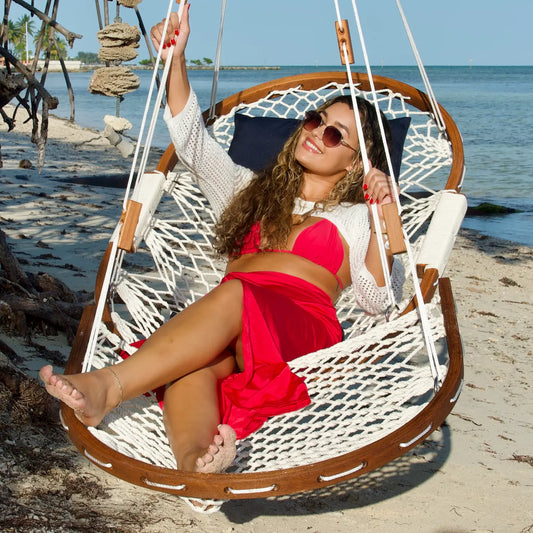
Hammock chairs come in as many styles and materials as hammocks do. The differences are in how you use them. A chair is for one person, it holds you in a more upright seated position, and it hangs from a single suspension point rather than two. That last part is why you'll find them in tighter spots than a full hammock will fit: on a porch, indoors, or in a yard with only one good tree to hang from. The best ones have enough material that you can tuck your heels up in front of you and recline with your feet up.
Low: shake out debris, rinse, take down for winter
Rope (cotton)
Covered porch
Poor — cotton holds water
Moderate: keep it dry, store fully dry
Brazilian / Colombian
Covered porch, sunroom, indoors
Poor — cotton cloth, keep it sheltered
Moderate: bring in when the weather turns
Traditional Mayan (cotton)
Indoors, or sheltered and brought in
Low — comes in ahead of wind or rain
High: fine cords snag; not for pets or rough use
Caribbean Mayan (polyester)
Porches, under trees, tight spaces (needs high anchor points)
Good — weather-resistant polyester, no wood
Low: closes up so debris doesn't collect; take down for winter
Caribbean
Open yard, deck, uncovered
Good — weather-resistant polyester
Low: shake out debris, rinse, take down for winter
Quilted
Sheltered spots, cooler weather
Poor — soaks up rain, catches wind, heats up in sun
High: slow to dry, hard to clean, no real repair path
Camping
Trail, campsite, short stays
Short term only — sun degrades the fabric
Low, but not a year-round backyard hammock
What Size Hammock Should I Buy?
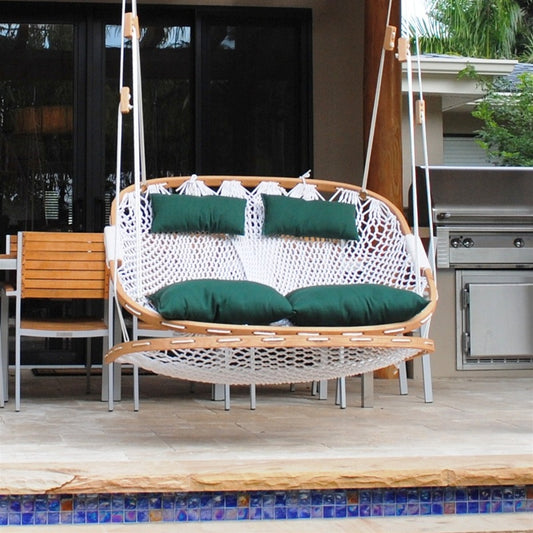
Buy the biggest hammock that comfortably fits your space. A single (under 48 inches wide) suits porches and tight spots, a double (48 to 54 inches) lets one person sprawl or two share, and a jumbo (55 inches or wider) fits two with room to spare. Length matters more for comfort than width, so check the space you need before you choose.
Single hammock — under 48 inches wide
Best for tighter or smaller spaces like porches or sunrooms. Consider a Mayan hammock or a hammock chair.
Double hammock — 48 to 54 inches wide
Plenty of room for one person to sprawl out, and cozy enough for two to curl up together.
Jumbo hammock — 55 inches or wider
Roomy and luxurious for one, spacious for two, with room to spare for a child or the family pet.
Hammock chair — made for solo relaxation
Perfect for solo relaxation in tighter spaces and indoor rooms, and just as good for anyone who prefers a more upright position for reading or catching up with someone.
How Much Space Do You Need for a Hammock?
Plan on 14 to 15 feet between anchor points for a spreader bar hammock, at least 11 feet for a Mayan hammock with hanging points at least 5 feet high, and a single anchor point at least 8.5 feet off the ground for a hammock chair.
These are the numbers I'd plan around. They're deliberately generous. A hammock stretches as it breaks in, and extra distance is easy to take up with a length of chain, but a span that's too short can't be fixed.
Spreader bar hammocks
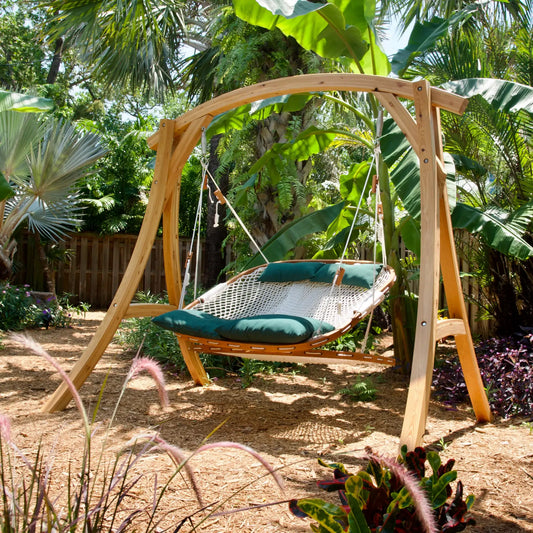
Plan on 14 to 15 feet between your anchor points. Around 13 feet is the bare minimum for a jumbo, and it leaves you nothing to work with once the hammock settles. Set your hanging points at roughly 5 feet high and hang it loose with a gentle curve, not tight and flat. The Jumbo Caribbean is rated to 500 lb. No trees or posts? A hammock stand takes the guesswork out of it; here's how to choose between metal and wood.
Mayan hammocks
A Mayan needs less room side to side, but more height. Allow at least 11 feet between anchors, and more if you have it, with hanging points at least 5 feet off the ground. Because of that deeper curve, a Mayan won't hang properly on a standard hammock stand, so plan on trees, posts, or ceiling or wall joists.
Hammock chairs
A chair hangs from a single point that needs to be at least 8.5 feet off the ground. If you have a little more height than that, use it. Our Jumbo hammock chairs are rated to 300 lb, and they don't come with hanging hardware, so plan for that too. See ways to hang a hammock chair almost anywhere.
For a hammock that lives outdoors, polyester rope is the best material: it's soft, colorfast, quick to dry and resistant to rot, mold and mildew. Cotton is gentle on the skin but belongs on a covered porch or indoors. Pair the rope with solid outdoor wood spreader bars and stainless steel hardware.
A hammock comes down to three materials: the cotton or polyester it's woven from, the wood of the spreader bar, and the metal of the end rings and suspension. Get any one of those wrong and the life of the hammock is cut short, no matter how good the other two are.
Is polyester or cotton better for a hammock?
Polyester is better outdoors; cotton is best kept to covered porches and indoor spaces. Long gone are the days when polyester meant a stiff, slick, shiny fabric reserved for uncomfortable shirts and grandpa's flared trousers. Modern polyester can be every bit as soft, breathable and comfortable as cotton, and it's also colorfast, resistant to rot, mold and mildew, and quick to dry. Best for outdoor, uncovered spaces.
Most Central and South American hammocks are woven from natural cotton, either as a cloth like the hammocks of Colombia and Brazil, or as fine cords like the Mayan hammocks of the Yucatán. Cotton has the appeal of being a natural fiber and a really gentle touch on the skin, but it doesn't handle weather and rain well, so it's best kept to covered porches and indoor spaces. More in polyester vs cotton hammocks.
Wood spreader bars
Look for a quality outdoor wood, well oiled or coated in marine varnish so the weather doesn't get to it. And look for one solid piece. Laminated bars and two-piece bars joined by a metal bracket in the middle exist for one reason: a shorter bar means a smaller box and cheaper shipping. That's a saving for the seller, not for you.
Metal components
Metal end rings and chain vary in quality. Zinc plated sits at the bottom, galvanized is a step up, and stainless steel is the gold standard, especially in wet or coastal conditions. Look for a large diameter and a heavy gauge while you're at it. Hammocks that don't end in a metal O-ring tend to wear out faster, because the ends are where nearly all the stress is concentrated.
Cord thickness
Finer cord and thinner cloth do make for a more comfortable hammock, but you pay for it in durability. The ultra-fine cords of a traditional Mayan snag and break with very little provocation. Heavy rope is the opposite trade: tougher on the skin, but almost impossible to ruin. Our Caribbean was designed to sit between them, on a cord fine enough for comfort and strong enough for the weather and kids playing.
Hammock ends — where all the stress goes
The bed is what you feel, so that's where the attention goes. But the ends are what decide how long the hammock lasts. Every bit of weight in the bed travels up the end cords, through the O-ring and into your suspension, and the ends are where it all concentrates. More end cords, and thicker ones, spread the load across the full width of the bed. A well-tied clew knot then delivers that load into the ring evenly, so no single cord is doing more work than the rest.
What Makes a Hammock Comfortable?
A comfortable hammock has lots of fine cords in one continuous, close weave, end cords balanced so a pocket forms under you, enough length to curve, and a soft, loose hang rather than a tight, flat one.
The most comfortable hammocks don't happen by accident. They take thought, skilled handwork, and good quality materials.
The bed
It's the part you actually lie on, so it had better be made right. Start with the cord count: the more cords in the bed, the more surface area your weight is spread across. Finer cords make for a more comfortable bed too, right up to the point where they're so delicate you can't relax without worrying about breaking them.
The weave
One continuous weave, with no knots or obstructions anywhere in the bed, so it can make small adjustments around your body and relieve pressure points as you settle in. The closer the weave the better, as long as it still leaves openings small enough to keep air moving through. Ours is woven so closely that we call it the Micro Weave.
The end cords
The more end cords there are, the more evenly your weight gets distributed, and the better the hammock feels underneath you. But the number alone isn't enough. The end cords have to be balanced so the center of the bed carries a little less tension than the edges, which is what lets a pocket form under you. That balance comes from getting three things right together: the thickness of the rope, its length, and the amount of twist laid into it. Get them right and you have enough stretch and flex for the middle to settle into a pocket. Get them wrong and you end up lying on a tight, flat board.
The size
Bigger is better, and I'd encourage you to buy the largest hammock that comfortably fits your space. But most of that comfort comes from length rather than width. A longer hammock has the room to form a gentle curve underneath you, and that curve is what you're really lying in. Extra width mostly just makes room for more people to pile in.
The wood spreader bar
Traditional Mayan hammocks versus hammocks with wood spreader bars is the age-old argument in this industry. In my opinion, both styles can be extremely comfortable, provided the weaver understood the dynamics outlined above. That's the part nobody argues about, and it's the part that actually decides it. A well-made hammock of either style beats a poorly made one of the other every time. Here's the two side by side, or read the full Mayan vs spreader bar hammock comparison.
The hang
Assuming you've got a quality hand-woven hammock, the hang is what makes or breaks it. Tight and flat feels uncomfortable and unstable. Soft and loose, with a gentle curve through the bed, is cozier and far more balanced to get in and out of or share with a friend. Our tree-hanging guide covers how much slack to leave and how high to set your straps.
How Do You Lie in a Hammock Correctly?
Sit down in the middle of the bed, bring one leg in and then the other, and work your way to the center. Then lie at a slight angle across the bed rather than straight down the middle, and spread out so your weight is carried by as many cords as possible.
There's no wrong way to use a hammock. If you're in it and enjoying it, you're doing it right. That said, there are a few things that will make the experience noticeably more comfortable.
Graceful entry
Take it slowly. Sit down toward the middle of the bed and get settled before you commit. Then bring one leg in, then the other, and work your way to the center. The center is the trick. Off to one side, your weight is unbalanced and the hammock will roll you right out onto the grass.
Spread yourself out
The more cords your body makes contact with, the more evenly your weight gets distributed. So spread yourself out across the whole bed. Kick out a knee, drop an elbow, and let the hammock take you where it wants to. Hammock aficionados never lie straight up and down the middle. They lie at a slight angle across the bed, which is what flattens it out underneath you.
Find your sweet spot
Never fight the hammock or try to make it conform to you. Take a minute to make small adjustments in angle and position until you land on the one that makes you go “ahhhhh.”
Once you've found it, the hard part is staying put. Twenty minutes in a hammock makes the case for doing exactly that.
How Do You Clean and Care for a Hammock?
Shake out debris whenever you walk past, take the hammock down ahead of storms, and wash it while it hangs with a garden hose and a little mild soap, then let it dry completely in the sun. Store it fully dry in a lidded tote or indoors over winter.
Some people never bring their hammock in, while others store it away at the sight of a dark cloud on the horizon. The sweet spot is somewhere in between. Hang yours with hardware that makes it easy to take down, and bringing it in stops being a chore you keep putting off.
Give it a shake
Polyester itself is highly resistant to mold and mildew, but the bed can collect debris from trees and wildlife, and that material will break down and stain if it sits. Every time you walk past, flip the hammock over and give it a good shake to clear it out.
Hang it with hooks
A hammock you can take down in thirty seconds is a hammock you'll actually take down. Hang yours on hooks or S-hooks rather than tying the suspension off permanently, so unhooking it ahead of a storm or at the end of the season is a one-minute job instead of an afternoon's work. It also lets you unhook one end and shake the bed out without dismantling anything. The no-hardware rope method covers the S-hook setup in detail.
Wind is the real problem
Rain and sun take their toll over time, but the worst damage I've seen comes from wind. A hammock left up in a storm catches every gust and spins, and every rotation twists the end cords tighter until one of them finally gives.
How do you clean a hammock?
Leave the hammock hanging and rinse it down with a garden hose. Add a little mild detergent — dish soap works fine — and use a soft brush on any stubborn spots. Rinse until all the soap is out, then leave it hanging to dry. Pick a sunny, breezy day and it'll be dry before evening.
How do you store a hammock for winter?
Give the hammock a quick wash the way I outlined above, and make sure it's completely dry before you roll it up. Storing a damp hammock for the winter, or for any long stretch without use, is asking for mildew. More in how to care for, clean and store your hammock for winter.
Rodents and insects
I've lost count of the customers buying a second hammock who told me the first one didn't die outdoors — it died in storage. A family of mice moved in over the winter, or something found the folded cotton and decided it was a nest. Store yours somewhere sealed, in a bin or a tote with a lid rather than a loose bag on a shed floor.
What Size Hammock Chair Do I Need?
Go by the width of the spreader bar: 40 inches for tight spaces and smaller people, 48 inches for most adults, and 55 inches for the most room. If you're between sizes, go wider.
Our hammock chairs are sized by the width of the spreader bar. The wider the bar, the more shoulder room you get, and the more comfortable the chair feels.
Not just bigger, it's the biggest. Add to that stainless steel suspension rings, thicker end cords and Micro Weave in the seat. Jumbo Caribbean Hammock Chairs
Subscribe to our emails
Be the first to know about new collections and exclusive offers.
Choosing a selection results in a full page refresh.