
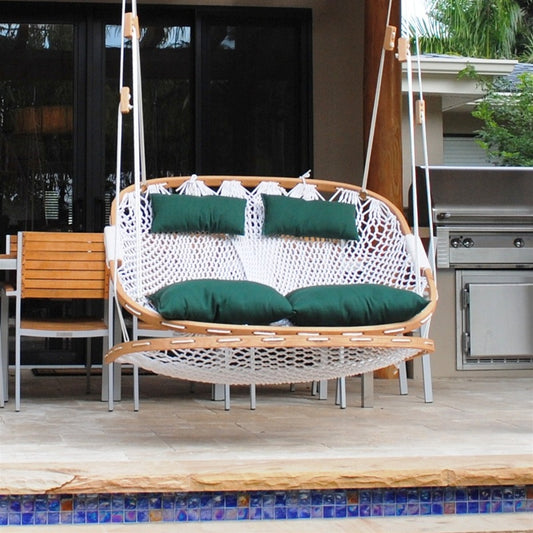
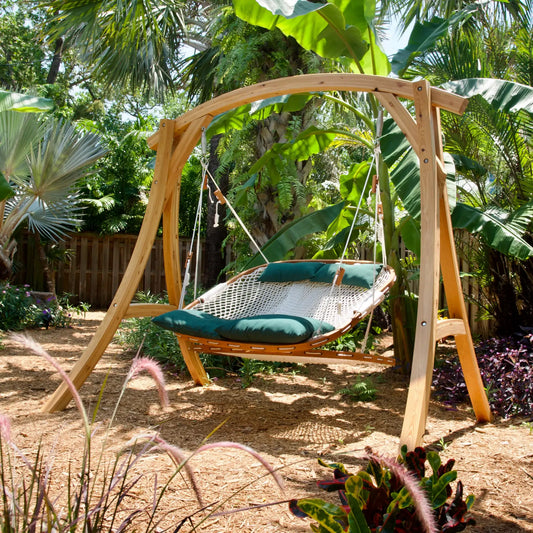

How to Hang a Hammock with Rope: No Straps, No Hardware

My name is Paul Ashwell, and I spent twenty-five years behind the counter of a hammock shop explaining to people everything I know about hammocks. Of all the questions that came across that counter, one came up more than almost any other: what is the easiest, simplest way to hang a hammock between a couple of trees?
People expect a complicated answer. They expect me to sell them a system. But the way I like to do it at my own cabin uses two things you can pick up for a few dollars: a length of rope and a three inch S hook. No fancy knots to remember, no hardware to bolt into a tree, and nothing you cannot pack into a bag and take to the beach with you.
Here is how I do it.
What you need
- Rope. I use a braided nylon rope I buy on Amazon. Mine has a 500 pound carrying capacity.
- Two three inch S hooks. Mine cost about a dollar each at the hardware store.
- Your hammock, with a metal ring at each end. Every rope hammock we make finishes in a stainless steel ring, which is exactly what the hook clips into.
That is the whole list.
Your two trees
Before you tie anything, look at what you are hanging from. You want two trees roughly 14 to 18 feet apart, and if you have a choice, err on the wider side — extra distance you can take up with rope, but there is nothing you can do about trees that are too close together. Both of them should have been in the ground a couple of years and rooted themselves properly. A six inch trunk is plenty; how long the tree has been there matters more than how thick it is.
Choosing your rope
The single most important thing is to make sure you get rope that is strong enough to hold you. Do not eyeball it. Look at the rated capacity on the packaging and pick something with room to spare above your own weight, because every knot you tie takes some strength out of a rope, and a hammock does not load gently when you drop into it. More capacity than you need costs almost nothing. Not enough costs you a bruised back.
I like braided nylon. It handles well, it holds a knot, and it wears well outdoors. I also like it in green, which sounds like a small thing until you see it on a tree. Green disappears into the natural environment. It matches the trunk, it matches the leaves, and when you are not lying in the hammock you barely notice the rope is there at all.
One more piece of advice from years of watching people run short: buy more rope than you think you need. If you end up with extra length, you simply tie your knot further along the rope. If you end up short, there is nothing you can do about it. Thick trunks in particular eat up rope faster than people expect, so start long.
The S hook
The hook is a plain three inch S hook, the sort of thing that hangs on a peg at the hardware store for about a dollar. There is nothing special about it. It is simply the piece that lets you clip the hammock on and, more importantly, unclip it again later. I will come back to why that matters.
Method one: rope, one simple knot, and an S hook
This is my favorite way to hang a hammock between two trees.
- Fold the rope in half, right in the middle, so you have a loop at one end and two loose ends at the other.
- Pass the folded end around the tree so the loop comes back around to meet you.
- Pass the two dangling ends through the loop and pull.
- Cinch it down nice and tight against the trunk.
- Tie an overhand knot in the two ends together. That is the simplest knot there is, the one you already know, the first half of tying your shoelaces. Pull it snug.
- Slip the S hook in behind the knot so the knot holds it in place.
- Clip the metal ring on the end of your hammock into the S hook, and check that everything is cinched up tight.
Repeat on the second tree and you are done. If you need to shorten things up, tie your overhand knot at a different point along the rope. If you are working with a thicker trunk, go back to the start and use a longer piece of rope.
As for how the hammock should sit: hang it loose, with a gentle curve, rather than pulled tight and flat. A hammock strung up tight sits on a pivot and is far easier to tip out of. And once you are lying in it, you want the lowest point of the bed sitting fairly close to the ground, so that if anything ever does let go, you have a very short distance to fall.
"Won't it just slide down the tree?"
This is the question I get every single time, and the answer is no. It works the opposite way to how people imagine. The moment you put weight into the hammock, that loop cinches tighter around the trunk. The more load you put on it, the more firmly it grips. There is no mechanism for it to slide down.
Why I use the hook: taking it down again
Here is the part most people do not think about until they are standing at the tree with a pocket knife.
Knots tighten. Every time you lie in that hammock, the knot at the tree pulls a little harder on itself. Give it a season of use and some knots become so tight that getting them off the tree is genuinely difficult.
With the S hook setup, none of that is your problem. Unhook the hammock, take out the S hook, and the suspension rope comes off the tree in seconds. That is what turns this from a permanent installation into something you can throw in a bag and take to the park or down to the beach.
Method two: no hook at all
If you do not have an S hook, you can do the whole thing with rope alone. I use this method myself when I am caught without hardware.
Start the same way: fold the rope in half, pass it around the tree, pass the two ends through the loop, and cinch it tight. Then bring your hammock over and thread the two rope ends through the ring on the end of the hammock, one from each direction. Slide it to the length you want, and tie your overhand knot to lock it there.
The key to getting this right is the direction of the two ropes. One rope comes up from the bottom and through the ring. The other goes down from the top and through. If you thread them both the same way, the whole thing has a tendency to slip once your weight is in it.
It works, and it adjusts nicely. The drawback is the same one I mentioned above: with time and weight, that knot will tighten down to the point where you will struggle to undo it. That is why my preference is still the pair of dollar S hooks.
The last step
Whichever method you use, there is one thing left to do before you invite anyone else to try it. Get in it yourself, carefully, and make sure it is going to handle your weight. Every tree, every rope, and every knot is a little different, and thirty seconds of testing tells you more than any article can.
If your trees are not cooperating, or you would rather hang from straps than tie knots, I walk through that approach in my guide to hanging a hammock between two trees with tree straps.
And once it is up, do not let it sit there empty. I wrote a little about what twenty minutes in a hammock actually does for you here.
Paul Ashwell is the founder of Key West Hammock Company and has been designing, selling and using hammocks for more than twenty-five years.